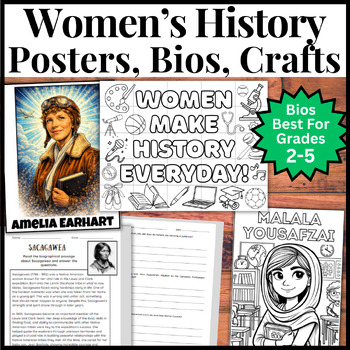
A hallway display can give children a reason to stop and read. For Women’s History Month, start with a few portraits and a question: “Whose story would you like to learn more about?” Leave room for the board to grow as your class reads.
I found a collection that would work nicely for this kind of display because it pairs portraits with reading and a shared art project. You can choose a small selection and build the board around what children learn.
Give each portrait a short introduction
The Women’s History Month Bundle for grades 2–5 includes 30 comic-style portrait posters, 11 biographies with questions, 34 coloring pages, an Eleanor Roosevelt bonus portrait, and a collaborative poster.
Choose two or three people whose work connects to your current lessons. Read the selected passages before planning your discussion so you can provide context and support with unfamiliar vocabulary. Keep a copy available near the display for readers who want to return to the story.
Let children write the captions
Ask partners to agree on one contribution they want other children to know about. Have them explain it aloud, check it against the passage, and write a short caption for the portrait.
For younger writers, offer “She worked to…” or “Her work mattered because…” and help them finish the thought accurately. Older elementary students could add a question that sends a reader back to the biography.
Add a shared centerpiece
The bundle’s “Women Make History Every Day” collaborative poster comes on 25 numbered landscape pages that assemble in a five-by-five arrangement. That would make a strong centerpiece, with student captions and portraits displayed around it.
Measure your space and plan the arrangement before handing out the pages. You can work on the poster over several days while the reading lessons continue.
Prefer a reading-table version?
The smaller Women’s History Biography Bundle contains eight biographies with three written-response questions each, plus a Maya Angelou coloring page. It would suit a reading group when you do not need a full display collection. These biographies overlap with the larger bundle, so choose the set that fits your plans.
Neither of these biography collections includes comprehension answer keys. Preview the questions and prepare for the discussion ahead of time.
As March goes on, add children’s new captions and questions. A board that changes with the reading gives the class something worth checking again.