“It is good.” A perfectly respectable opinion about a strawberry. As a description, though, it leaves the reader with a little detective work.
Try this short first-grade describing-words lesson when children are ready to add one useful detail to their writing. A food picture gives everyone something to look at, and a little partner talk gets the words moving before pencils come out.
Put just a few pictures on the table
The 52 Fruit and Vegetable Coloring Pages Bundle from Use The Village includes 25 fruit pages and 27 vegetable pages, each with an English name. I like having that many choices while only needing three or four for a lesson.
Choose familiar foods and provide a photograph alongside each outline picture. Children can color their page after the word work. No tasting is needed, and everyone can take part whether they have eaten the food or simply seen its picture.
Collect words children can explain
Ask, “What do you notice about its shape or color?” Record a few suggestions under two headings: “Color” and “Shape.” Point back to the photograph as children explain their choices. If someone offers a taste word, ask whether it comes from their own experience; a picture alone cannot tell us how something tastes.
Keep the word bank small enough to use. Four helpful words beat a crowded chart that nobody can find their way around.
Say a sentence before writing it
Model a plain sentence, such as “I see a carrot.” Then add a detail supported by the picture: “I see a long carrot.” Ask what the new word helps the reader imagine.
Partners take turns saying a sentence about their chosen picture. Offer “I see a ___ ___” for children who need a starting place. Others can describe two visible features. Invite a child to point, use their usual communication support, or dictate while you write.
Revise one thing and celebrate it
Have children write or dictate their sentence, then underline the describing word together. Read the sentence aloud and check that it matches the picture. The goal is one clear detail, so there is no need to fill a whole page.
Keep a few finished sentences beside the word bank for tomorrow. For another use of the same pictures, this pretend classroom market gives children a reason to use those food words in conversation. Suddenly, “the long orange carrot” has a customer waiting for it.
A resource for this activity
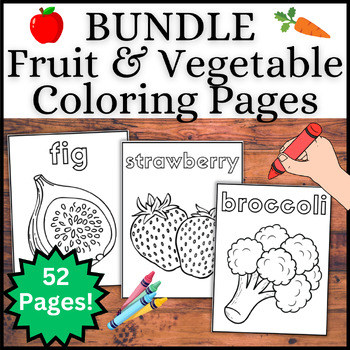
52 Fruit and Vegetable Coloring Pages Bundle
Choose a few labeled food pictures for oral sentences and descriptive writing.