Several children, a stack of colored pages, and one big poster to assemble. Someone has a plan. Someone else has the tape. Those two people may need a quick conversation.
A collaborative poster gives children a concrete reason to explain an idea and listen to a partner. A little rehearsal before assembly can make the teamwork easier.
Prepare a manageable assembly job
The Solar System Collaborative Poster includes 25 pages that form a display of the Sun and eight planets. Printed on US Letter paper, the finished display is approximately 55 by 42.5 inches, so clear a suitable work area first.
Follow the resource’s assembly guidance yourself before inviting children to help. Prepare any trimming that needs adult attention. Give a small group a few neighboring pages to check rather than handing over the entire stack at once.
Practice three useful phrases
Model the language with two pages before distributing jobs:
- “I think this page goes here because…”
- “Can we check the picture?”
- “Are we ready to attach it?”
Point to a visible line or part of the illustration that continues across an edge. Explain what you notice, then ask a partner to look. Children can point or gesture as part of their explanation.
Give each partner something to do
One child suggests a placement. Another checks how the picture joins. An adult can handle attaching the pages, or supervise that step as appropriate. Rotate the suggesting and checking jobs after a placement.
Keep the pages loose until the group has checked them. Tape is wonderfully confident. It will happily commit to a decision nobody has finished discussing.
If children disagree, return to the shared picture and the resource’s guide. Ask each child to show their clue. You can model changing your mind when a better match becomes clear.
Make participation flexible
A child can contribute by pointing to a matching edge, holding a page steady, or choosing between two possible placements. Offer a phrase card if speaking on the spot is difficult.
Keep coloring participation flexible, too. One child might color a larger area while another adds a small detail. The amount of coloring does not need to determine whose ideas count during assembly.
Reflect on one helpful exchange
Once the poster is ready, ask, “What did someone say that helped us?” Prompt children to notice a clear explanation, a request to check, or a patient response.
Reuse the same phrases during puzzles, building tasks, and shared art. The finished display can also become a solar system question wall for a separate science lesson.
Keep the teamwork lesson focused on how children solve a shared problem. A few thoughtful exchanges are a useful success, even when an adult does most of the final mounting.
A resource for this activity
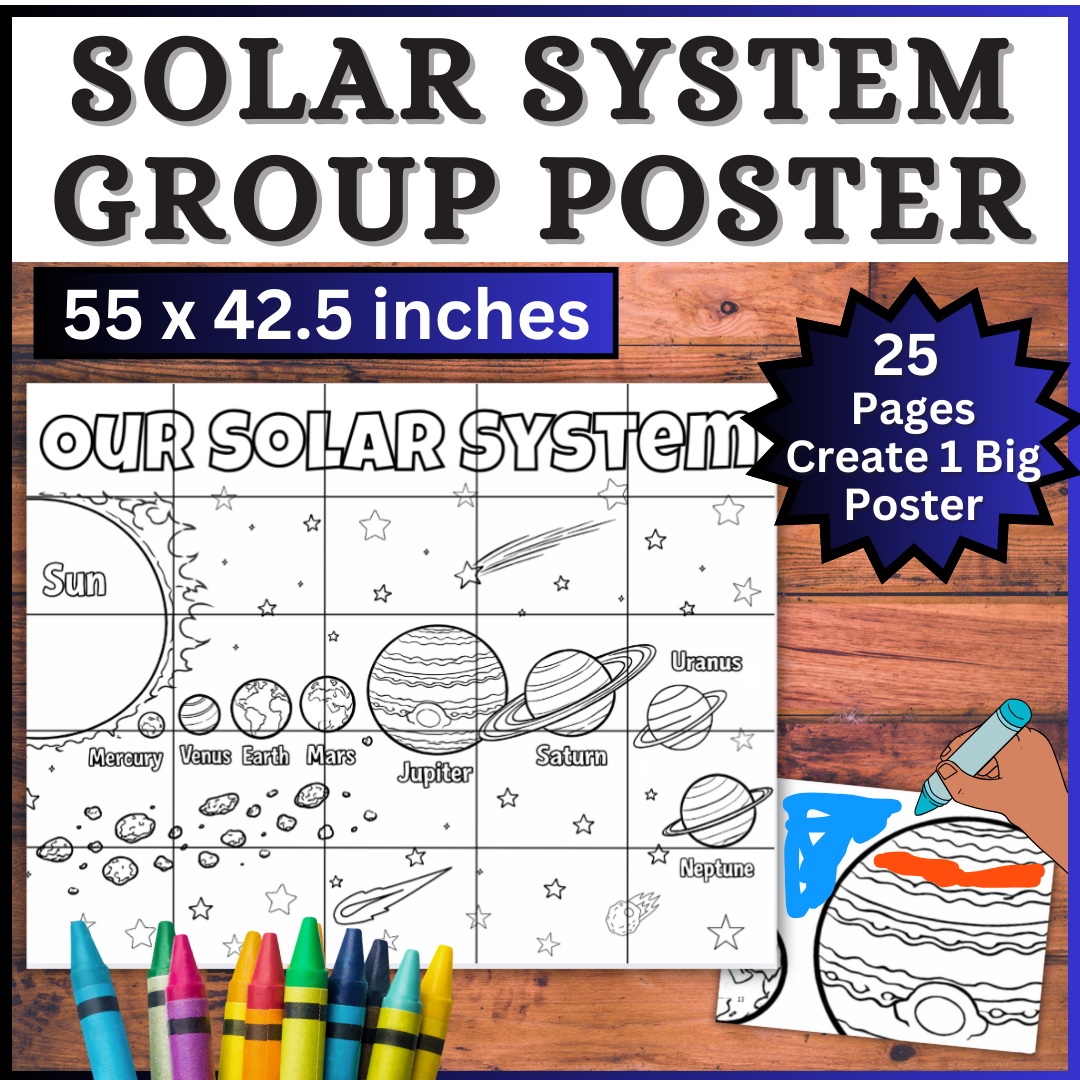
Solar System Collaborative Poster
Twenty-five coloring pages form one large space display. Use a small portion of the assembly process to practice suggesting, checking, and agreeing on a placement.