Ask how a story character feels, and “happy” and “sad” often get plenty of work. They are useful words. A small word bank can give children a few more choices when the story calls for them.
Keep this read-aloud extension short. Two new words and one good conversation will do nicely.
Prepare a small feelings word bank
The Identifying Emotions Sorting Mats include seven feelings and 42 photographs. The named feelings are happy, sad, excited, angry, surprised, silly, and scared.
Choose two or three relevant mats as vocabulary references beside your read-aloud. Introduce each word with a simple explanation and a pretend example. For “surprised,” you might describe opening a box and finding something unexpected.
Use the photographs as examples of possible expressions. People can show the same feeling in different ways, and a face alone cannot tell us everything someone feels.
Stop where the story gives you a clue
Choose a moment when something meaningful happens to a character. Ask, “Which of these words might fit here?” Point to the word bank and let children choose, speak, or gesture.
Follow with, “What happened in the story that makes you think that?” Return to the words or illustration together. You are helping children connect a feeling word to the story.
If the text names the feeling, read that part again. If it leaves the feeling open, model tentative language: “The character might feel excited because…”
Give two answers room to breathe
One child may choose surprised while another chooses scared. Ask each to share a story clue. Both ideas may be reasonable, or another part of the text may help the group reconsider.
A word bank offers support, so allow children to suggest a word beyond it. A character can also have more than one feeling at a time. Stories do enjoy making things interesting.
Revisit the character later
Pause again after the situation changes. Ask whether the same word still fits. Move a teacher-made name card beside a different mat if children can explain the change.
Keep the discussion about the fictional character. Children can participate without sharing private experiences or performing an expression for the class.
Save one sentence
Finish with a shared sentence: “At this part, the character might feel ___ because ___.” Write the children’s idea and reread it together.
For a separate lesson introducing the pictures, see noticing clues in a feelings photo sort. Bring the same familiar words back to your next book so children have another chance to use them.
A resource for this activity
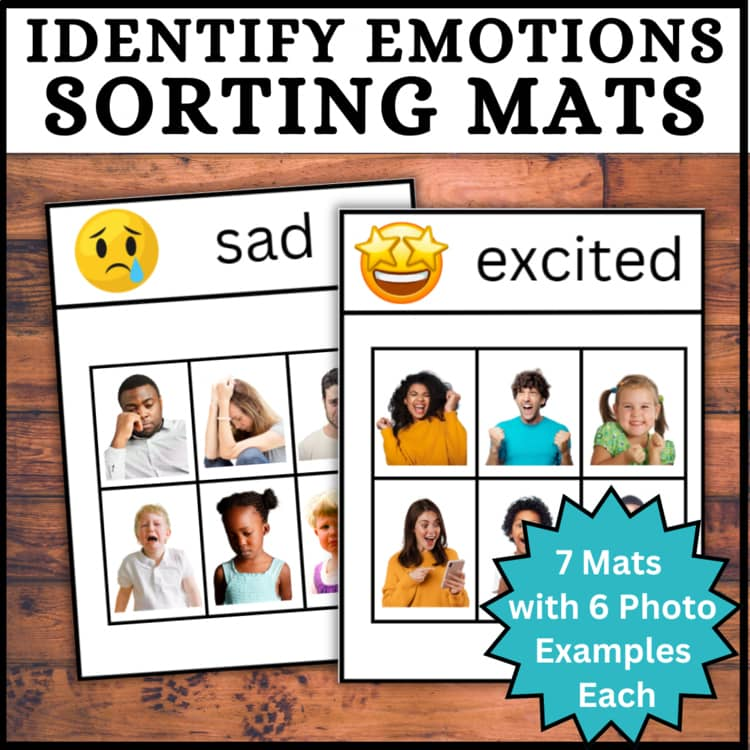
Identifying Emotions Sorting Mats
Seven feelings mats and 42 photographs can support a small vocabulary reference during a read-aloud. Select only the words useful for your story.