A child has a whole story ready to tell. Then comes the first word they cannot spell, and the pencil stops. You know that hopeful little look across the room.
A personal picture dictionary gives young writers a place to look for a few words they use often. Start with one topic and a handful of pictures. There is no need to assemble an entire encyclopedia before Monday.
Choose words children have a reason to use
Ask children what they want to write about this week. Pets? A trip? Their favorite food? Pick four to six useful words from that conversation.
The 255 Vocabulary Coloring Pages Bundle from Use The Village offers pictures across 11 themes, including animals, food, vehicles, household items, and clothing. I like it for this project because you can pull from different topics as children’s writing interests change. Use only the pages you need.
Build a small reference children can navigate
Put selected labeled pages in a thin folder. If your printer supports reduced-size printing, you could print a few on each sheet, keeping labels large enough to read. Children can color their pictures and add a simple picture tab for the topic.
For a first folder, topic sections are enough. A child looking for a vehicle can turn to the vehicle tab without searching through 26 alphabet sections. Add another section when there is a real need for it.
Teach the looking-up part
Model the whole process with a sentence of your own. Say your sentence aloud, pause at a word in the folder, find its picture, and point to the printed label. Write the word, then reread your sentence.
- “What word am I looking for?”
- “Which picture will help me find it?”
- “Does my sentence still say what I wanted?”
Keep encouraging children to use the sound-spelling patterns they know. The dictionary is especially handy for topic words whose spellings they have not learned yet. Help with the rest of the sentence as needed.
Let it stay personal
Two children can have very different folders. One may need animals; another may be planning an impressive number of stories about trucks. Add a child’s own drawing and a teacher-written label when a needed word is missing.
Children who are not writing independently can point to a picture, say a sentence, or dictate it. For multilingual learners, invite a home-language label alongside the English word when a knowledgeable adult can help confirm it.
At the end of writing time, ask, “Did your folder help you find a word?” Keep the useful pages and set aside the ones nobody reaches for. For practice turning a picture word into a more detailed sentence, try these describing-word activities.
A resource for this activity
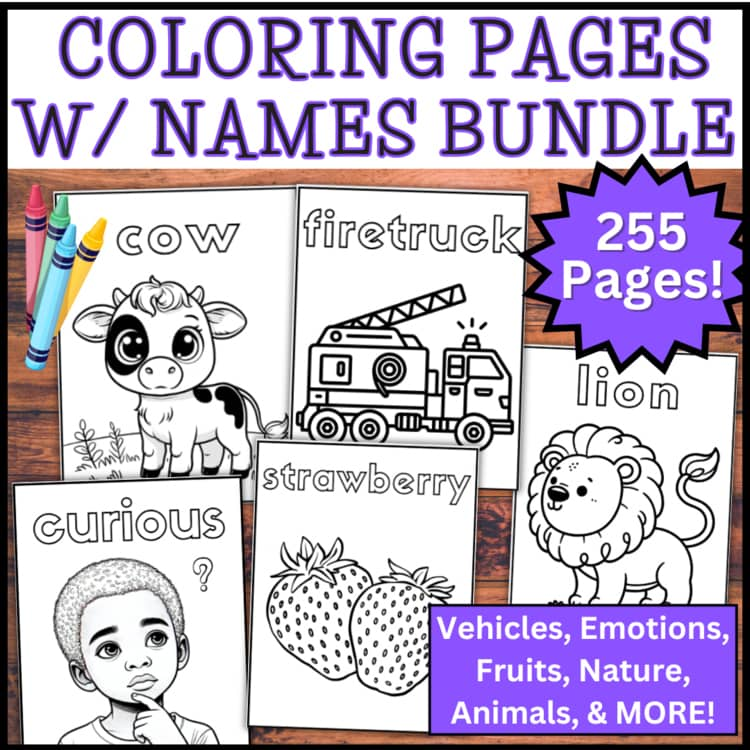
255 Vocabulary Coloring Pages Bundle
A collection of themed pictures and words to draw from as you build small, personal writing references.