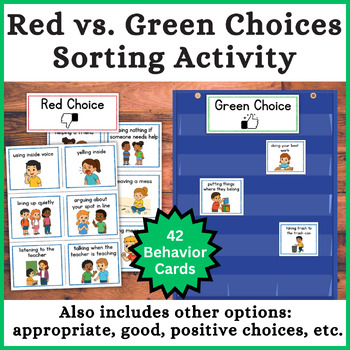
You have reminded the class to make good choices. Five minutes later, someone grabs a crayon from a classmate, and another child looks genuinely puzzled about what went wrong.
For some young learners, “good choice” needs a picture, an example, and plenty of chances to figure it out. A red and green choices sorting activity gives children a concrete job: look at a behavior picture, decide which group it belongs in, and place it under the matching heading. It is a simple way to practice telling appropriate and inappropriate classroom behaviors apart while everyone is calm.
Start with two clear examples
Choose one picture of a helpful behavior and one of a behavior that could hurt someone or interrupt their learning. Describe exactly what is happening. “This child is asking for a turn. This child is grabbing.” Then ask, “Which choice helps both children?”
Explain your labels in simple language: green choices help us stay safe and learn together; red choices need a different action. Keep the focus on the behavior. Every child gets another chance to choose.
Try a five-minute picture sort
Set out red and green headings with just four to six pictures. Keep the words or symbols on the headings visible so children have more than color to guide them.
- Look: “What is the child doing?” Describe the action together.
- Choose: Invite the student to place the picture under a heading or point to their answer.
- Explain: “What might happen next?” A short answer, gesture, or supported choice is enough.
- Try again: For a red choice, ask, “What could the child do instead?” Model the alternative together.
If a child guesses, talk through that picture and try it again later. Leave plenty of time to respond. The useful part is hearing or seeing how the child understands the situation.
Picture cards for the sorting activity
The Red and Green Choices Behavior Cards from Use The Village give you 42 illustrated examples to choose from. The set includes several heading options and blank headings, so you can use familiar classroom language. Pull a small selection for today’s discussion and save the others for another day.
Use the cards for a teacher-led sort first, then let students sort a familiar selection with a partner or individually. A pocket chart or two headings on the table is all you need.
Make the practice easier to access
For preschoolers, kindergarteners, and students in special education who benefit from explicit visual practice, start with two contrasting pictures and model the first answer. Let students point, match, place a card, or use their usual communication system. Reading aloud and explaining in full sentences can be optional.
Repeat familiar examples before adding new ones. Choose behaviors that matter for that student, and make sure the expected alternative is something they can do with the support available. Movement, sensory needs, and different ways of communicating deserve that same consideration.
Help the idea carry into the school day
After sorting a picture about taking turns, practice asking for a shared classroom item. When you notice that choice later, name it: “You asked for a turn and gave your friend time to answer.” That connects the picture to something the child actually did.
Keep the cards handy for another brief practice tomorrow. Recognizing a behavior in a picture and managing it in a busy classroom can take different kinds of support.
For a related small-group activity, explore these feelings scenarios and matching ideas.