By the 100th day, your class has collected a lot of stories. There are routines they know by heart, skills they have practiced, and probably a few classroom moments everyone remembers. That makes the day a lovely opening for writing.
You can keep the familiar counting celebrations and add one imagination-filled writing choice. Here is a way to make it work without setting up an entire rotation of new activities.
Give the idea some talking time
Begin with a playful question of your own: “What would our classroom look like 100 years from now?” Let partners trade ideas before asking anyone to pick up a pencil.
Ask a follow-up that helps children develop the scene. What would students learn? What would their desks look like? What would stay exactly the same? Record a few useful words where everyone can see them.
Offer a choice that fits different writers
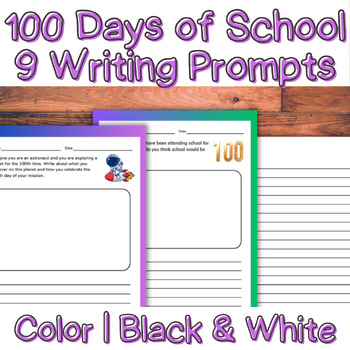
I found the 100th Day of School Writing Bundle especially useful for this angle. It has nine prompts across general 100th day, space, and time-travel themes, with drawing boxes, writing lines, continuation pages, and color and black-and-white options.
Choose two prompts to offer rather than handing out the full collection. Children can draw first, rehearse a sentence with a partner, or dictate an idea before writing. Keep continuation pages nearby for the student whose story is already heading into chapter two.
Make sharing short and comfortable
Invite pairs to read one favorite sentence to each other. The listener can ask a question about the imagined world or name a detail they could picture clearly.
Then let each writer decide whether to add something. A small revision feels purposeful when a real reader has wondered about the story.
Build a class display around the writing
The 100th Day of School celebration bundle includes a collaborative poster on 25 pages, eight coloring pages, a certificate, and a bonus writing prompt. That would be a cheerful display option if you want a shared centerpiece for the children’s writing.
Print only the parts you plan to use. Place a few student sentences around the poster and leave space for the rest in a class book.
Before the day ends, ask children to name something they can do now that felt difficult at the beginning of school. Those small, specific answers are worth saving alongside the imaginative stories.