Put a feelings photo in front of a small group and you may hear three confident answers before you finish the question. Happy! Excited! Silly! There is your conversation starter.
For children who need extra practice with emotion words, a photo sort gives everyone something concrete to look at. Keep the group small, choose only a few photos, and make space for children to explain their thinking.
Begin with two feeling words
These Identifying Emotions Sorting Mats from Use The Village caught my eye because they include real photographs: seven mats and 42 photos, with six photos for each feeling. The feelings are happy, sad, excited, angry, surprised, silly, and scared.
For a first round, choose two mats and four photos. Say the words, point to the labels, and explain that you are thinking about how each person might feel. Keep the other mats tucked away. A table full of 42 photos is quite a lot of feelings before snack.
Notice first, then choose a mat
Model two separate steps: “I notice a smile. I wonder if this person feels happy.” Invite children to point to something they can see before choosing a mat.
- “What do you notice about the face or body?”
- “Which feeling word could fit?”
- “What else might be happening?”
A photograph gives clues, but it cannot tell us everything about a person’s feelings. If a child makes a reasonable different choice, explore it together. You can place the photo between two mats while you talk. The printed grouping can guide vocabulary practice without turning every discussion into a guessing test.
Practice one gentle check-in
After sorting, introduce a sentence children can use with a real person: “How are you feeling?” Give a pretend example, such as a puppet sitting quietly beside a game. Children might wonder whether the puppet is sad, tired, or simply watching. Let the puppet answer.
This little exchange gives the activity a useful ending: notice, wonder, then ask. Avoid inviting children to sort classmates by how they look or asking anyone to share a private experience.
Make participation comfortable
Offer pointing, a spoken word, or the child’s usual communication method. Reduce the choices if the sort feels busy. You can place a photo beside a mat and ask the child to agree, move it, or show another possibility.
On the next day, bring back a few familiar photos before adding a new feeling word. Listen for a child using a word with more confidence or offering a clue. That gives you a useful next step for your small group.
For a later activity that adds a little story context, see these feelings and scenarios matching ideas.
A resource for this activity
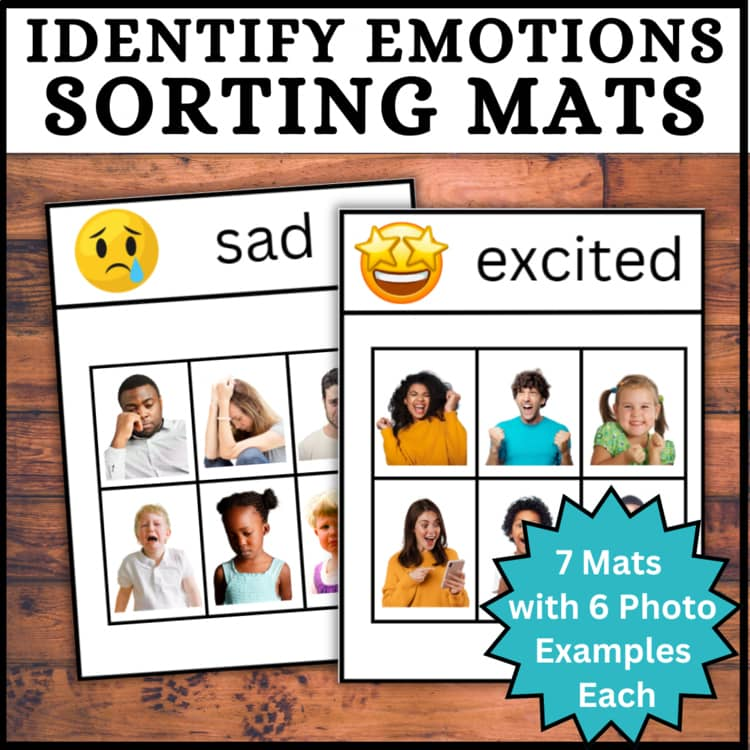
Identifying Emotions Sorting Mats
Seven feelings mats and 42 real photos for supported sorting and conversation. Use a few at a time and leave room for different interpretations.