“They look sad!” A child has noticed something. Now comes the part that can take a little practice: what could they say next?
A feelings activity can give children a quiet place to rehearse a caring question before they need it in the busy middle of a school day. Keep the lesson short, use pretend situations, and let children try out the words.
Begin with one situation
The 5 Cut & Paste Emotions Matching Worksheets connect pictures of people with everyday scenarios. Choose one scenario to read aloud. Ask what feeling might fit and what in the situation makes the child think so.
Leave the glue aside for a moment. Once the glue stick arrives, it tends to consider itself the main event.
Accept more than one reasonable interpretation. “They might feel disappointed” leaves room for uncertainty. A picture or situation gives us clues; asking the person helps us learn more.
Add one caring question
After discussing a possible feeling, model a question a child could actually use:
- “Are you okay?”
- “Would you like help?”
- “Would you like me to sit with you?”
Pick one phrase for the group to practice. Three new scripts at once can be a lot when a child is still working on getting the first words out.
Practice listening to the answer
Use a simple pretend example: a character’s drawing tears. One partner asks, “Would you like help?” The other answers, “Yes, please,” or “No, thank you.” Then switch roles.
Talk about what happens next. If the character wants help, they can ask an adult for tape. If they decline, the partner can say, “Okay.” Children can offer kindness without deciding what another person must want.
Keep touch out of the required response. A friendly question gives the other person a choice. For an injury or unsafe situation, practice getting a trusted adult right away.
Make the words easy to reach
Write the chosen question on a small teacher-made reminder card. Children can point to it, use their usual communication system, or practice with an adult instead of performing for a group. Avoid asking anyone to share a personal upsetting experience.
Return to the worksheet and let children complete the matching. Then ask, “Which question could you try in that situation?” The extra conversation can be just a minute.
Notice the next step
At the end, listen for two things: can the child offer a caring question, and can they make room for the answer? Keep practicing with fictional examples as needed.
For the initial matching lesson, see feelings and scenarios in a small group. This follow-up adds a practical response after children have considered how someone might feel.
A resource for this activity
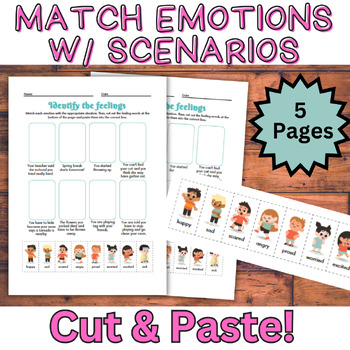
5 Cut & Paste Emotions Matching Worksheets
Use a scenario as a starting point for matching feelings, then rehearse one caring question. Includes five printable activity pages.