Twenty-five pages, a room full of crayons, and one mysterious empty space in the middle of the poster. Page 17, where have you gone?
A collaborative poster is much easier to manage with a plan for the paper. Here is a simple way to organize a Black History classroom display while keeping the learning about the person at its center.
Choose one person and one poster
The Black History Month Collaborative Poster Bundle from Use The Village includes separate posters for Rosa Parks, Jackie Robinson, Martin Luther King Jr., and George Washington Carver. Each poster uses 25 printable pages. I like being able to choose the person who connects with the class reading and save the other projects for later.
Begin with an age-appropriate biography or read-aloud. Talk about something the person did and why it mattered. Keep that book available as children work so the display has a clear connection to what they are learning.
Give every page a home
Check the assembly directions before handing anything out. Make a quick checklist of the page numbers, then record who has each page. Use two folders labeled “Still working” and “Ready to assemble.” Ask children to keep the page number visible.
If your class has fewer than 25 children, spread the extra pages across another short session. If you have more, offer partners a shared page or another useful job. Everyone can contribute without needing an identical assignment.
Offer jobs beyond coloring
Some children may enjoy checking page numbers, organizing crayons, or helping plan where a finished page belongs. Rotate these jobs and provide adult help with trimming or assembly as needed.
Show children how neighboring pages connect before they begin. Agree on any colors that need to continue across a boundary, then leave room for individual choices elsewhere. Assemble on a table or the floor before attaching the poster to the wall.
Add a caption that comes from the reading
Invite each child to complete “I learned…” orally, in writing, or through dictation. Help them find support for the statement in the biography. Choose a few accurate captions to display beside the poster, with the book title nearby.
End by asking, “What would you want another class to learn from our display?” For a follow-up, these Black History gallery-walk questions can help students talk about what they see and read. Keep the page checklist tucked in your folder for the next project. Future you will appreciate it.
A resource for this activity
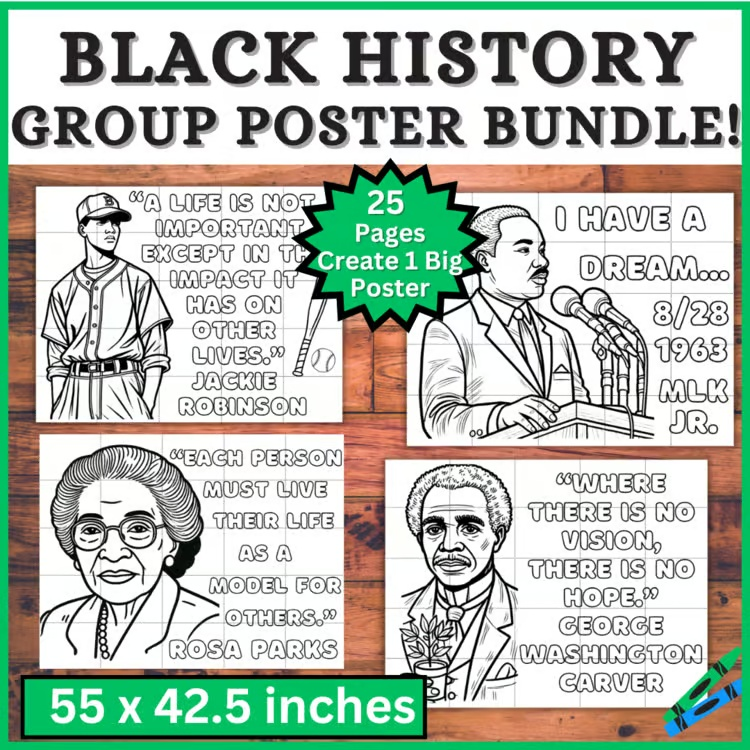
Black History Month Collaborative Poster Bundle
Four separate collaborative posters. Choose one to accompany the biography your class is reading.