A child puts a picture under green, then looks up to see whether you approve. Was it a thoughtful choice or a lucky placement? One gentle question can help you find out.
After a few familiar rounds of a red and green choices sort, invite children to explain one card. Keep the conversation concrete and brief. You are looking for an understanding of the action in the picture.
Start with a small, familiar sort
The Red and Green Choices Behavior Cards from Use The Village include 42 illustrated cards, several heading options, and blank headings. I like the flexibility of choosing just a few pictures that connect with situations children understand.
Use four to six cards at first. Read the heading words aloud and pair them with simple symbols so color is not the only clue. Explain that you are sorting choices in a particular classroom situation. The labels describe actions, not children.
Name the action before choosing a side
Ask, “What is happening in this picture?” Help with vocabulary or explain the situation if needed. A child may recognize the picture without yet knowing the words to describe it.
Then ask, “Where would you put it? What helped you decide?” Offer a short frame such as “This helps because…” or “This could hurt because…” Choose language that fits the specific card.
Pointing, a gesture, or the child’s usual communication method can show understanding, too. There is no need to turn a two-word answer into a speech.
Make a different choice discussable
If a child sorts a card differently, first find out what they think it shows. Perhaps they imagined a different situation. Describe the context again, then invite another look.
For a pretend example, grabbing a shared marker can keep someone else from finishing. Asking for a turn gives both children a way to use it. Use an example like this only when it fits the selected picture; the conversation should clarify the action children are actually sorting.
When a picture needs more context, set it aside to discuss together. Quiet voices, movement, and talking can be appropriate at different times. Keep the explanation connected to the situation.
Add one “What could help?” question
After discussing a red choice, ask what someone could do instead. Accept one workable idea and model the words if needed: “Can I have a turn when you finish?”
Use a puppet or an adult demonstration for a brief practice. Avoid asking children to act out unsafe behavior. Keep real classmates’ mistakes out of the discussion.
Return to one card another day
Bring back a familiar picture and listen for the explanation. Can the child name the action or suggest an alternative with a little less help? Make a quick note and choose the next few cards accordingly.
For the initial sorting setup, see these red and green choices activity ideas. The follow-up can stay as small as one card and one useful conversation.
A resource for this activity
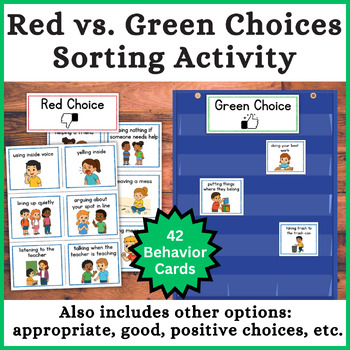
Red and Green Choices Behavior Cards
Choose a small set of illustrated actions for sorting, explaining, and discussing a helpful alternative.